









Caribbean citizenship by investment is available not only to individuals but also to families. Spouses, children, parents, grandparents, and siblings can apply together.
The participation of multiple family members doesn’t necessarily mean higher costs, as some countries offer highly favourable options specifically for families.
This article explains who can obtain Caribbean citizenship alongside the main investor and how inheritance and family reunification work in these programmes.
5 Caribbean countries with citizenship by investment for families
Citizenship by investment programmes are offered by:
A foreigner can obtain a Caribbean passport in 4—8 months. The minimum investment amount is $200,000.
Investors get second passports from Caribbean states without traveling there, as the entire process can be completed remotely. The exception is St Kitts and Nevis, where applicants must provide their biometric data and collect their Certificate of Registration in person.
Caribbean citizenship programmes do not require residency, except in Antigua and Barbuda, where applicants must spend at least 30 days within 5 years after obtaining citizenship.
Trusted by 10,000+ investors
Compare Caribbean citizenship by investment programmes
Caribbean passport for family members: who can initially be included in the application
Spouses. All five Caribbean programmes allow spouses to be included, provided they are of the opposite sex and legally married, without additional restrictions.
Minors. Children under 18 are automatically eligible.
Adult children. Caribbean CBI family inclusion rules allow financially dependent children aged 18 to 30 to join the application. In St Kitts and Nevis, the maximum age is 25.
Children with disabilities can be included at any age, regardless of financial dependency.

Lyle Julien,
Investment programmes expert
If a family member is not included in the initial application, Antigua and Barbuda, St Lucia, Grenada, and Dominica allow them to apply later through a family reunification process. The eligibility requirements and costs for adding family members vary by country.
Siblings. Eligibility varies by country:
- Antigua and Barbuda — allowed at any age if unmarried;
- Grenada — allowed if over 18, unmarried, and without children;
- St Lucia — allowed only if under 18;
- Dominica and St Kitts and Nevis — not allowed.
Parents of the main applicant or their spouse are eligible for inclusion, but age restrictions and financial dependency requirements apply. In Antigua and Barbuda, parents must be over 55 years old, while in Dominica, the minimum age is 65.
Grenada does not impose an age limit but requires financial dependency. In St Kitts and Nevis and St Lucia parents must be at least 55 years old to qualify.
Grandparents. Not all countries allow their inclusion. In Antigua and Barbuda, grandparents must be at least 55 years old and financially dependent. Dominica sets the minimum age at 65, while Grenada allows grandparents without an age limit as long as they rely on the investor.
St Kitts and Nevis and St Lucia do not permit grandparents to be included in the application.
Family members who can be included in the application

Country
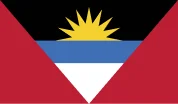
Children
Under 30, financial dependency not required
Parents
Over 55, financially dependent on the investor
Grandparents
Over 55, financially dependent on the investor
Siblings
Of any age, unmarried
Country

Children
Under 30, financially dependent on the investor
Parents
Financially dependent on the investor
Grandparents
Financially dependent on the investor
Siblings
Over 18, unmarried, without children
Country
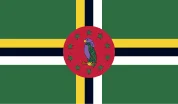
Children
Under 30, financially dependent on the investor
Parents
Over 65, financially dependent on the investor
Grandparents
Over 65, financially dependent on the investor
Siblings
Cannot be included in the application
Country

Children
Under 25, financially dependent on the investor
Parents
Over 55, financially dependent on the investor
Grandparents
Cannot be included in the application
Siblings
Cannot be included in the application
Country

Children
Under 30, financially dependent on the investor
Parents
Over 55, financially dependent on the investor
Grandparents
Cannot be included in the application
Siblings
Under 18, with parent or guardian’s consent
Country | Children | Parents | Grandparents | Siblings |
|---|---|---|---|---|
Under 30, financial dependency not required | Over 55, financially dependent on the investor | Over 55, financially dependent on the investor | Of any age, unmarried | |
Under 30, financially dependent on the investor | Financially dependent on the investor | Financially dependent on the investor | Over 18, unmarried, without children | |
Under 30, financially dependent on the investor | Over 65, financially dependent on the investor | Over 65, financially dependent on the investor | Cannot be included in the application | |
Under 25, financially dependent on the investor | Over 55, financially dependent on the investor | Cannot be included in the application | Cannot be included in the application | |
Under 30, financially dependent on the investor | Over 55, financially dependent on the investor | Cannot be included in the application | Under 18, with parent or guardian’s consent |
How much does a Caribbean passport cost for a family?
The total cost of Caribbean citizenship by investment is not limited to the investment. Applicants also pay government, processing, Due Diligence, application, and other administrative fees, which vary by country, investment option, and family size. As a result, the final cost for a family can be considerably higher than the programme’s minimum investment threshold.
Antigua and Barbuda
Antigua and Barbuda allows investors to choose between the four investment options[1]Source: Antigua and Barbuda — Official Citizenship by Investment Unit:
- Non-refundable contribution. A minimum of $230,000 to the National Development Fund for single applicants or families of up to four members.
- Real estate investment. A minimum of $300,000 in a government-approved real estate project.
- Donation to a higher education institution. Families of six or more can contribute $260,000 to a local educational facility. The contribution allows 1 year of tuition for one family member.
- Business investment. A minimum of $1.5 million as a sole investor in an approved business. Alternatively, a group of investors can make a joint investment of $5 million, with each contributing at least $400,000.
Due Diligence fees are $8,500 for the main applicant, $5,000 for the spouse, $2,000 for dependents aged 12 to 17, and $4,000 for those over 18.
Processing fees total $20,000 for a family of four. For additional dependents, an extra $10,000 applies.
Grenada
The National Transformation Fund provides a straightforward route to citizenship with a $235,000 non-refundable contribution for single applicants[2]Source: Grenada — Official Citizenship by Investment Committee.
For those seeking a money return, Grenada offers real estate opportunities starting at $270,000, paired with a $50,000 government fee for families of up to four members.
Due Diligence costs $5,000 for each applicant aged 17 and above.
Dominica
Dominica offers a lower entry point without compromising benefits. Investment options include[3]Source: Commonwealth of Dominica — Official Citizenship by Investment Unit:
- Non-refundable contribution. Single applicants can contribute $200,000 to the Economic Diversification Fund, while families of up to four need to invest $250,000.
- Real estate investment. A minimum investment of $200,000 in a government-approved property, plus state fee of $75,000 for single applicants and $100,000 for families of up to four members.
Due Diligence fee for the main applicant is $7,500, while dependants aged 16 and above are vetted for $4,000 each. Processing fee is set at $1,250 for the main applicant and $250 per dependant.
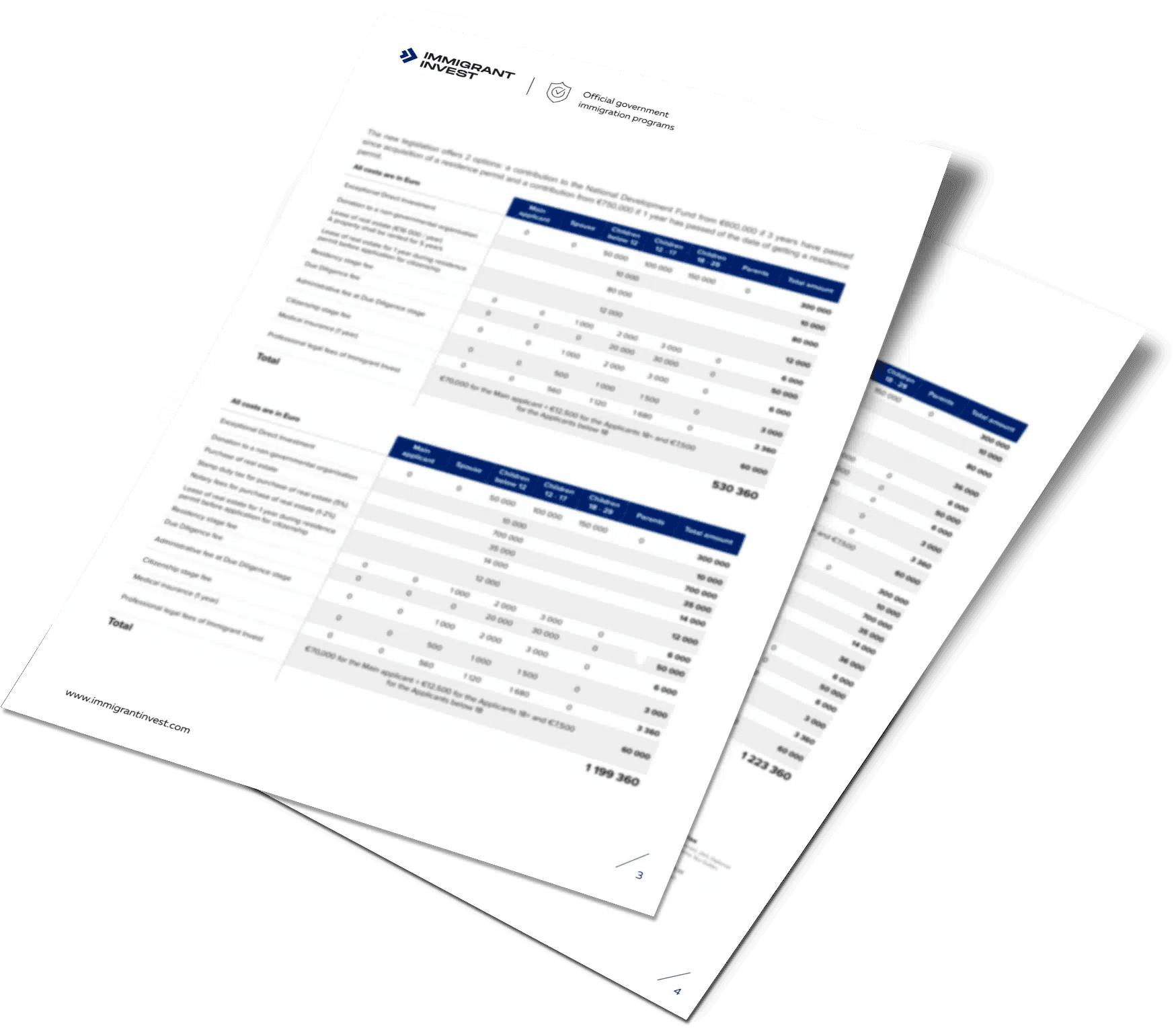
St Kitts and Nevis
The Sustainable Growth Fund is a popular choice, requiring a contribution of $250,000 for a single applicant and for a family of up to four[4]Source: St Kitts and Nevis — Official Citizenship Unit.
For those interested in real estate, the programme offers investments starting at $325,000 in government-approved projects, such as luxury resorts and developments. Alongside the investment, a state fee is $25,000 for the main applicant and $40,000 for a married couple.
The Due Diligence fee is $10,000 for the main applicant, $17,500 for a married couple, and $7,500 for dependants aged 16 and older.
For families with three or more children, the Public Benefit Option, PBO, in St Kitts and Nevis offers a highly cost-effective option. While the standard contribution for a single applicant and families of up to four is $250,000, families with more children will see additional fees for each dependant, but still benefit from the flexibility and financial savings associated with this programme.
St Lucia
St Lucia offers multiple investment routes to cater to different investor priorities[5]Source: St Lucia — Official CBI programme website.
Investment options include:
- Non-refundable contribution. $240,000 to the National Economic Fund for a single applicant and for a family of up to four members.
- Government bonds. An investment of $300,000 in non-interest-bearing government bonds, held for 5 years. A minimum administrative fee is $50,000.
- Real estate investment. A minimum of $300,000 in a government-approved property, with a state fee of $30,000.
- Business investment. Applicants can invest in government-approved business projects with a minimum of $3.5 million individually or $1 million as part of a $6 million group. A $50,000 administrative fee applies.
- Infrastructure project investment. Applicants invest $250,000 in government-approved infrastructure projects in St Lucia, such as ports, bridges, and roads.
The Due Diligence fee for St Lucia is $8,000 for the main applicant and $5,000 for dependents aged 16 and older.
Minimum cost of second citizenship for families
Country
Married couple
$270,700+
Family of four, with spouse and two minors
$273,800+
Country
Married couple
$280,522+
Family of four, with spouse and two minors
$292,844+
Country | Married couple | Family of four, with spouse and two minors |
|---|---|---|
$270,700+ | $273,800+ | |
$263,200+ | $267,700+ | |
$270,600+ | $277,700+ | |
$280,522+ | $292,844+ | |
$262,100+ | $270,100+ |
Big family, small costs: affordable citizenship programmes for families with three or more kids
For larger families, citizenship costs can rise quickly as government and Due Diligence fees are charged per applicant. However, some Caribbean programmes offer options that become more cost-effective once several children are included in the application.
Families with three or more children
The Public Benefit Option in St Kitts and Nevis now offers better value for families with several children. Since August 1st, 2026, the $250,000 investment has covered a family of up to four, with government fees included in the amount.
This has brought the option in line with the programme’s non-refundable contribution route and made the overall cost more predictable for larger families.
Expenses for St Kitts and Nevis PBO option
Families of six or more people
For large families, Antigua and Barbuda offers one of the most cost-efficient citizenship by investment options. Through its higher education route, investors make a non-refundable contribution to an eligible institution. The contribution does not generate investment returns.
The option can be particularly relevant for families applying with adult children, as one family member under 29 is entitled to a 1-year university scholarship.
The total investment required for this option is $260,000. For a family of six, the processing fees are included in the investment. However, for a family of seven or more, an additional $10,000 is charged for each dependent starting from the seventh.
The Due Diligence fees are the following:
- main applicant — $8,500;
- spouse — $5,000;
- dependent aged 12 to 17 — $2,000;
- dependent over 18 — $4,000.
Also, there is a CIU interview fee of $1,500 per application, and each passport costs $300. A bank commission of $600 applies for the main applicant, $500 per adult dependant, $300 per child aged 12 to 17, and $200 per child under 12.
How investors and families obtain Caribbean passports: a step-by-step procedure
Fully remote process. Grenada, Dominica, and St Lucia allow investors and their families to complete the entire process remotely. Documents are submitted through a licensed agent, interviews are conducted online, and citizenship certificates are delivered to the applicant’s chosen address.
Partial travel requirement. St Kitts and Nevis allows remote document submission and interviews, but applicants must submit the biometrics data and collect their Certificate of Registration in person. In Antigua and Barbuda, the oath can be taken via videoconference, at a consulate, or in person.
Obtaining Caribbean citizenship usually takes 4—8 months.
1 day
Preliminary Due Diligence
Immigrant Invest conducts a preliminary check of the investor before signing a service agreement. The check helps to timely identify any risks of refusal and address them.
Immigrant Invest conducts a preliminary check of the investor before signing a service agreement. The check helps to timely identify any risks of refusal and address them.
2+ weeks
Document preparation
The investor collects a pack of documents required by the chosen programme. Immigrant Invest experts translate and notarise documents, when required.
The investor collects a pack of documents required by the chosen programme. Immigrant Invest experts translate and notarise documents, when required.
3—6 months
Due Diligence and application processing
A CBI unit of the chosen country conducts Due Diligence of the investor and their family against international databases.
At this step, applicants also undergo an online interview. When required, an interpreter is provided.
A CBI unit of the chosen country conducts Due Diligence of the investor and their family against international databases.
At this step, applicants also undergo an online interview. When required, an interpreter is provided.
1—2 weeks
Implementing the investment condition
Once the application is approved, the applicant makes the investment. Depending on the country and chosen route, the funds may be transferred either before or after the main Due Diligence checks are completed.
Once the application is approved, the applicant makes the investment. Depending on the country and chosen route, the funds may be transferred either before or after the main Due Diligence checks are completed.
Up to 5 months
Getting citizenship documents
After all checks are completed, the authorities issue an approval letter. Some programmes also require an oath of allegiance before the citizenship certificate is granted.
The passport is then issued, usually within several weeks, and is valid for 5 to 10 years depending on the country and holder’s age.
After all checks are completed, the authorities issue an approval letter. Some programmes also require an oath of allegiance before the citizenship certificate is granted.
The passport is then issued, usually within several weeks, and is valid for 5 to 10 years depending on the country and holder’s age.
Surge in Caribbean citizenship applications: trends and numbers
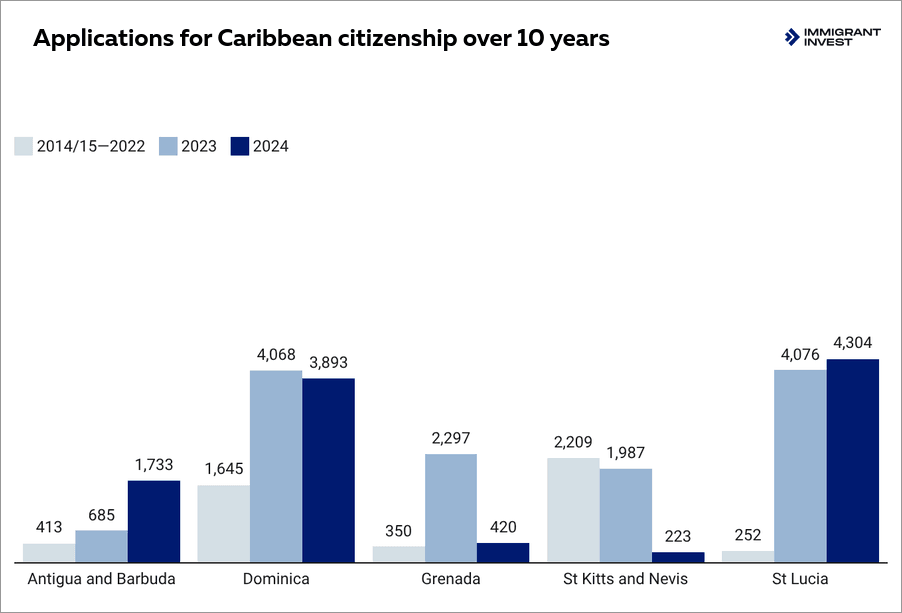
High approval rates. Over the past decade, more than 40,000 passports have been granted to investors and their families. In 2024 alone, Dominica issued 9,586 passports through its CBI programme[6]Source: European Commission — Eastern Caribbean CBI data, while Grenada granted citizenship to more than 5,400 investors and their family members[7]Source: IMA — Grenada Q4 2024 statistics.
Economic contributions. Funds from these programmes support infrastructure, healthcare, education, and disaster recovery.
Obtaining citizenship for relatives after the investor gets their passport
In almost every Caribbean country family reunification allows investors to extend citizenship to additional family members after they and their initially included relatives have already been granted citizenship.
For example, if an investor obtains citizenship along with their spouse and child but later decides to include their parents, they can do so without making a new investment, though additional fees apply.
Lyle Julien,
Investment programmes expert
Family reunification in Grenada is more limited than in most Caribbean citizenship programmes. After citizenship is granted, a spouse, parents, siblings, and other existing dependants cannot be added.
The exception is a newborn child: the child must be born within 12 months of the original application being filed and added within 6 months of birth.
In Antigua and Barbuda, children and parents can be added later, but within 10 years after approval.
In Dominica, most family members can be included later, except for parents and grandparents. The time when dependents may be added to an application is not limited.
In St Lucia, investors have up to 5 years after obtaining citizenship to add children, a spouse, and other eligible family members, provided they were qualifying dependants at the time the citizen’s original application was submitted. Family members who did not meet the eligibility requirements at that time cannot be added later.
In St Kitts and Nevis, post-citizenship additions are limited to family members whose circumstances change after the main applicant becomes a citizen. This can include a new spouse, children born later, and a parent who reaches the qualifying age afterwards.
A child born while the main application is still being processed may also be added before citizenship is granted. However, dependants who were already eligible but left out of the original application cannot use the post-citizenship addition route.
Timeframe and fees for adding family members to CBI programmes
Country
Time after investor’s approval
Within 10 years
Fee for children
$10,000 for a child up to 5
$20,000 for a child aged 6—17
$50,000 if over 18
Fee for a spouse
$50,000
Fee for siblings
$10,000 for a child up to 5
$20,000 for a child aged 6—17
$50,000 if over 18
Fee for parents
$50,000
Country
Time after investor’s approval
Within 1 year
Fee for children
$25,000
$5,520 of state duty
Fee for a spouse
Not applicable, a spouse cannot be added
Fee for siblings
Not applicable, siblings cannot be added
Fee for parents
Not applicable, parents cannot be added
Country
Time after investor’s approval
Within 5 years for children
Fee for children
$10,000 for a child up to 5
$15,000 for a child aged 6—17
Fee for a spouse
$75,000 within 1 year after investor’s approval, then $50,000
Fee for siblings
$50,000 within 1 year after investor’s approval, then $25,000
Fee for parents
Not applicable, parents cannot be added
Country
Time after investor’s approval
Within 5 years for children and siblings
Fee for children
$5,000 for a child up to 12 months
$1,000 of a processing fee
Fee for a spouse
$35,000 of a state fee
$5,000 of a Due Diligence fee
$1,000 of a processing fee
Fee for siblings
Not applicable, siblings cannot be added
Fee for parents
Not applicable, parents cannot be added
Country
Time after investor’s approval
Not specified
Fee for children
$7,500 for a child under 3 born after the Certificate of Registration is issued
$30,000 for other eligible children
Fee for a spouse
$30,000
Fee for siblings
Not applicable
Fee for parents
$30,000
Country | Time after investor’s approval | Fee for children | Fee for a spouse | Fee for siblings | Fee for parents |
|---|---|---|---|---|---|
Within 10 years | $10,000 for a child up to 5 | $50,000 | $10,000 for a child up to 5 | $50,000 | |
Within 1 year | $25,000 | Not applicable, a spouse cannot be added | Not applicable, siblings cannot be added | Not applicable, parents cannot be added | |
Within 5 years for children | $10,000 for a child up to 5 | $75,000 within 1 year after investor’s approval, then $50,000 | $50,000 within 1 year after investor’s approval, then $25,000 | Not applicable, parents cannot be added | |
Within 5 years for children and siblings | $5,000 for a child up to 12 months | $35,000 of a state fee | Not applicable, siblings cannot be added | Not applicable, parents cannot be added | |
Not specified | $7,500 for a child under 3 born after the Certificate of Registration is issued | $30,000 | Not applicable | $30,000 |
Can Caribbean citizenship be inherited?
Caribbean citizenship by investment is not only a lifetime benefit for the investor but can also be passed down to future generations. However, the inheritance rules vary depending on the country and the circumstances of birth.
Dominica — yes. Citizenship can be passed to children, including those born after the investor becomes a citizen, and can continue through future generations.
St Kitts and Nevis — yes. Citizenship is hereditary and can be passed to future generations. Children born after the investor becomes a citizen can also be added through the post-citizenship process.
Antigua and Barbuda — not automatically hereditary. Children born abroad to CBI investors do not automatically become citizens at birth. However, children under 18 are entitled to citizenship through registration: the citizen parent can apply on their behalf.
Grenada — yes, with conditions. An investor’s children can acquire Grenadian citizenship through their Grenadian parent. Grandchildren do not receive it automatically, but eligible adult grandchildren born abroad may apply separately if they meet the legal requirements such as having a Grenadian grandparent, being of good character, intending to serve Grenada, and taking the Oath of Allegiance.
St Lucia — yes, with limits. Children of the main applicant can obtain citizenship by descent, including those born after the investor becomes a citizen. However, this right does not automatically extend to grandchildren or the children of other dependants. If a descendant is born in St Lucia, they acquire citizenship by birth and can then pass it to their own children born abroad.
5 benefits to obtain Caribbean citizenship
A Caribbean passport can unlock far more than easier travel. It can widen business options, improve tax efficiency, and provide a reliable Plan B when circumstances change.
1. Visa-free travel to over 140 countries
Caribbean passports offer broad visa-free or visa-on-arrival access, including to the Schengen Area, Hong Kong, and Singapore. Grenada and Dominica also provide visa-free entry to China, while Grenada and Antigua and Barbuda retain visa-free access to the UK.
2. No residency or travel requirements
In most cases, the application process can be completed remotely. The exception is St Kitts and Nevis, where applicants must submit biometrics and collect their Certificate of Registration.
Investors are not required to live in the country. The only exception is Antigua and Barbuda, where new citizens must spend 30 days within the first 5 years.
3. Financial and tax advantages
Caribbean countries offer favourable tax regimes. None levies inheritance or capital gains tax, while foreign income is exempt or taxed only when locally sourced. Personal income is untaxed in Antigua and Barbuda and St Kitts and Nevis, with further exemptions available across the region depending on the jurisdiction.
4. Business and investment opportunities
Investors can register businesses, open bank accounts, and access international markets. Citizens of St Kitts and Nevis, Grenada, and St Lucia may qualify for multiple-entry US B-1/B-2 visas valid for up to 10 years[8]Source: U.S. Department of State: Reciprocity and Civil Documents by Country — St Kitts and Nevis, Grenada, St Lucia.
Grenada offers an additional advantage: its citizens are eligible to apply for the US E-2 Investor Visa, which allows investors to live in the US while developing and managing a business there.
5. Secure Plan B
A second citizenship can serve as a safe haven in times of political or economic uncertainty, giving investors and their families greater freedom to relocate when circumstances change. It can also preserve mobility when borders close or travel restrictions are introduced. Caribbean countries add to this appeal with political stability, robust legal frameworks, and a secure, peaceful environment.
How Immigrant Invest assists families with obtaining Caribbean citizenship
Immigrant Invest is a licensed investment migration company that has assisted investors and their families with citizenship and residence by investment since 2006. We support clients from programme selection through to obtaining passports and post-citizenship services.
For families applying for Caribbean citizenship by investment, Immigrant Invest provides:
- Licensed representation. We hold licences for Caribbean citizenship by investment programmes and submits applications through authorised channels.
- Preliminary Due Diligence. The Compliance Department checks applicants in advance and identifies potential risks before submission.
- Programme selection. Experts compare countries, investment options, family eligibility, and costs to recommend a suitable route.
- Document preparation and submission. Lawyers prepare the required documents, arrange translations and legalisation where needed, and submit the application.
- Investment support. The team assists with completing the chosen investment, including approved real estate where applicable.
- Post-citizenship support. We can assist with passport renewals, replacements, and other practical matters after citizenship is granted.
Our support helps ensure that dependant eligibility, fees, and document requirements are assessed correctly before the application is submitted.
Instead of conclusion: citizenship of which Caribbean country is right for your family
- All five Caribbean citizenship by investment programmes allow legally married, opposite-sex spouses to be included in the application without additional restrictions.
- Most countries permit financially dependent children up to 30 years old, except St Kitts and Nevis, where the limit is 25.
- Dominica has the strictest age requirement for parents; they must be at least 65. Antigua and Barbuda, St Kitts and Nevis, and St Lucia allow parents over 55.
- Grandparents are allowed in Antigua and Barbuda if over 55, in Dominica if over 65, and in Grenada without an age limit.
- Caribbean CBI citizenship can generally be passed to children, though the rules for grandchildren and future generations vary by country.
- Antigua and Barbuda allows children and parents to be added within 10 years, while St Lucia allows eligible relatives within 5 years. Dominica permits later additions without time limits, but parents and grandparents cannot be included. Grenada allows only newborn children within 12 months after the investor’s approval. In St Kitts and Nevis, additions are limited to relatives who become eligible after citizenship.
Immigrant Invest is a licensed agent for citizenship and residence by investment programs in the EU, the Caribbean, Asia, and the Middle East. Take advantage of our global 15-year expertise — schedule a meeting with our investment programs experts.

 Trusted by 10,000+ investors